

#Issue 3: The evolution of JavaScript from vanilla scripts to framework dominance
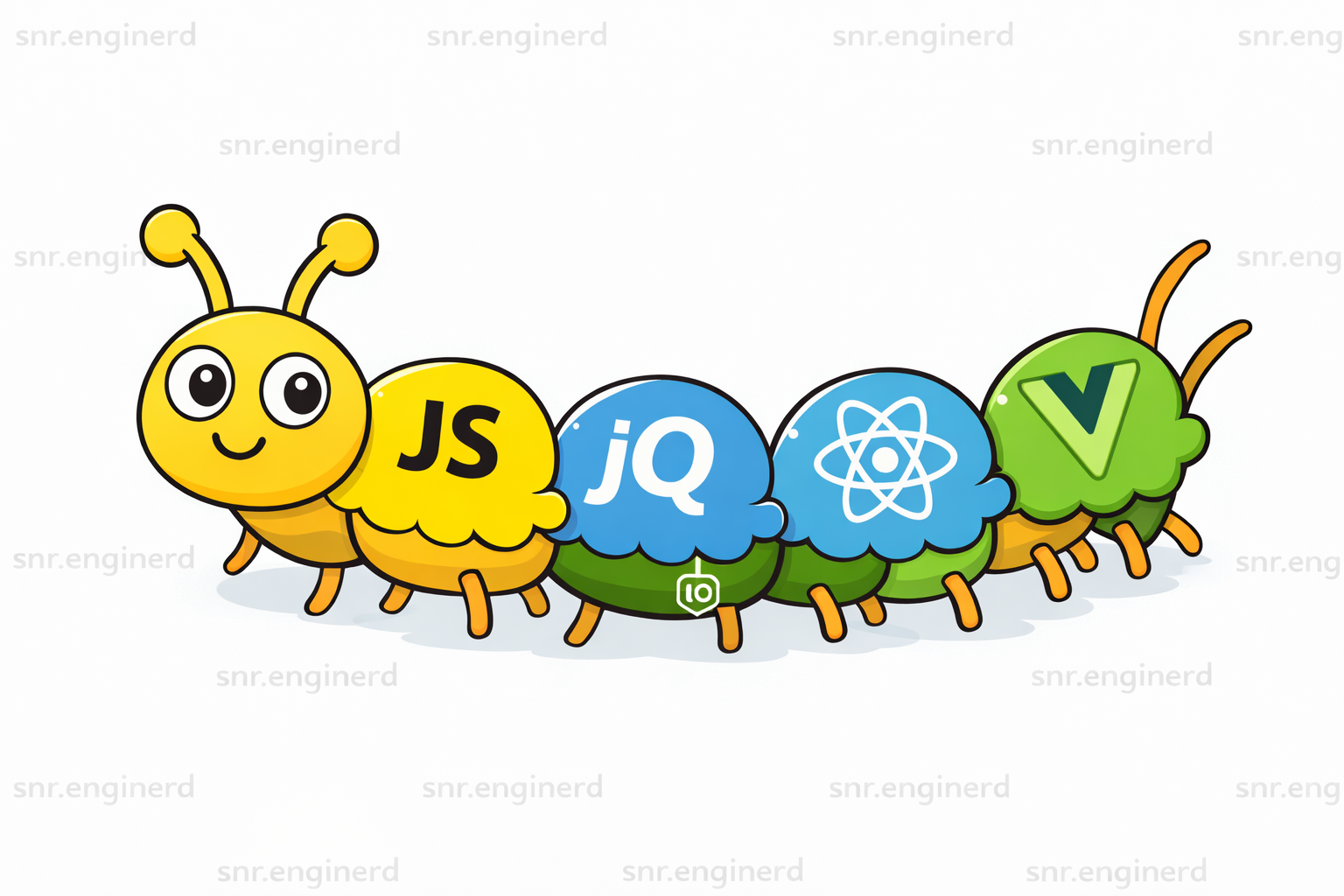
Quick disclaimer: I am not a JavaScript developer. I occasionally squint at JavaScript from across the room like it personally wronged me. So everything you're about to read should be taken with a generous pinch of salt—maybe even a whole shaker 😂. If you're a frontend engineer reading this, you have my permission to laugh at my takes.
Quick History
Back in the mid-2000s, the web was fundamentally different. If you wanted to add interactivity to a website, you were writing raw JavaScript—scrolling status bar messages, pop-ups, form validation. It was tedious, verbose, and often felt like you were wrestling with the language itself.
The jQuery Era: The Messiah Language We Thought We Needed
jQuery quickly became the de facto standard. If you were building websites in the late 2000s and 2010s, jQuery was the library you used. It solved the browser compatibility nightmare, made DOM manipulation feel almost elegant.
For nearly a decade, jQuery was synonymous with modern web development. It was going to heal the sick and solve world hunger, as some believed. And honestly, for its time, it did solve a lot of real problems.
The beauty of jQuery was simplicity. Instead of writing document.getElementById('myElement').style.color = 'red', you wrote $('#myElement').css('color', 'red'). Developers loved it.
The Disruption: Angular, React, and Vue.js
But nothing lasts forever in tech. The 2010s brought a fundamental shift in how we thought about building user interfaces.
Google announced AngularJS 1.0 in 2012, which was an early attempt at a full-featured framework. It was ambitious and opinionated, but also complex. Then React, released by Facebook in 2013, introduced the idea of component-based architecture and the virtual DOM. It wasn't just a library for selecting elements and manipulating the DOM—it was a new paradigm for thinking about UI. Instead of imperatively telling the browser what to do ("find this element, add a class"), you declaratively described what your UI should look like ("when the state is X, render Y"). This was revolutionary.
Vue.js followed in 2014, offering a more approachable entry point to this component-based, reactive world. While React gained massive momentum through Facebook's backing and its use in production across major tech companies, Vue carved out a loyal following with its elegance and gentle learning curve.
Suddenly, jQuery felt like yesterday's news ikr 😂😂😂
The Post-Framework Plateau: What We Have Now
According to the 2024 Stack Overflow Developer Survey, React and Vue rank among the most widely used frontend frameworks and libraries. Angular exists for enterprise teams who want everything batteries-included.
But fundamentally? The core paradigm hasn't shifted since React landed. We're still building components (by we I mean frontend engineers). We're still managing state. We're still thinking in terms of virtual representations of our UI.
Final Thoughts
Know what it was like building interfaces during the jQuery era or the React revolution? Or did you migrate projects from one framework to another? Share this post to your network and let me know your thoughts—I'll see it, I promise.