

Paradigm Shifts in Backend Development
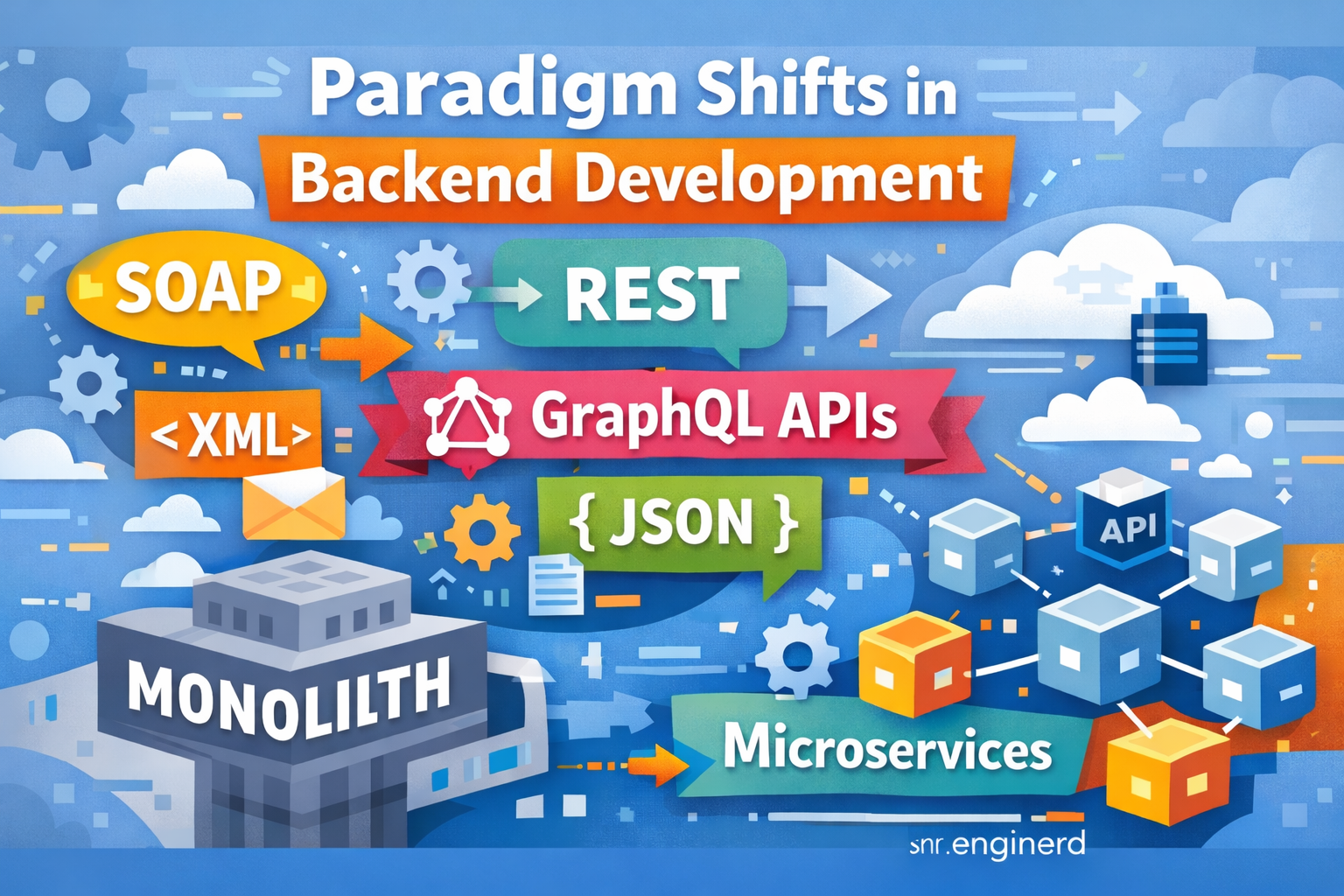
This is not a comprehensive list. These are personal observations from my own career, and I know many developers will relate.
Backend development keeps moving. Every few years, the "right" way changes, and we all adapt. Most shifts are not about replacing everything, they are about trade‑offs and context.
Here are three paradigm shifts that shaped how I think about APIs and backend systems.
1. SOAP to REST (from strict contracts to simple URLs)
When I started, SOAP already felt like history. I never built with it, but I did see the long shadow it left behind. SOAP was strict, formal, and contract‑heavy. REST felt like a breath of fresh air: URLs that made sense, simpler payloads, and tooling that was easier to reason about.
REST did not magically fix everything, but it lowered the barrier to entry. It became the default because it was simple and flexible.
2. XML to JSON (from verbose to readable)
This shift is the one I felt the most. XML was powerful, but noisy. JSON felt closer to the way we think in code.
A quick example in PHP:
$payload = [
  'user_id' => 42,
  'role' => 'admin',
  'active' => true
];

echo json_encode($payload);
JSON became the common language for APIs, especially in web apps. It was lighter, easier to parse, and easier to read. XML still has its place, but JSON won the everyday battle.
3. Monoliths vs microservices (from one big app to many small ones)
This one is messy. Microservices promised speed, ownership, and scalability. And for the right teams, they delivered.
But the truth is: microservices come with cost. More deployments. More monitoring. More coordination. More chances for something to break.
A lot of teams are now choosing "modular monoliths" or "well‑structured monoliths" because they get the clarity of a single codebase without the operational chaos.
What about GraphQL?
GraphQL felt like the REST killer when it arrived. It was powerful, especially for complex front‑ends. But REST did not die. GraphQL became another option — not a replacement.
That is the pattern I keep seeing: new things rarely erase old things. They just add another tool to the belt.
Final thoughts
Paradigm shifts are inevitable. The key is to not fall in love with any single approach. Know the trade‑offs. Stay curious. And do not let the hype make decisions for you.
If you are newer to backend development, here is the good news: you do not need to master every shift at once. Start with the basics, and let your experience guide the rest.