

My Experience with Triggers, Observers, and Events in Laravel
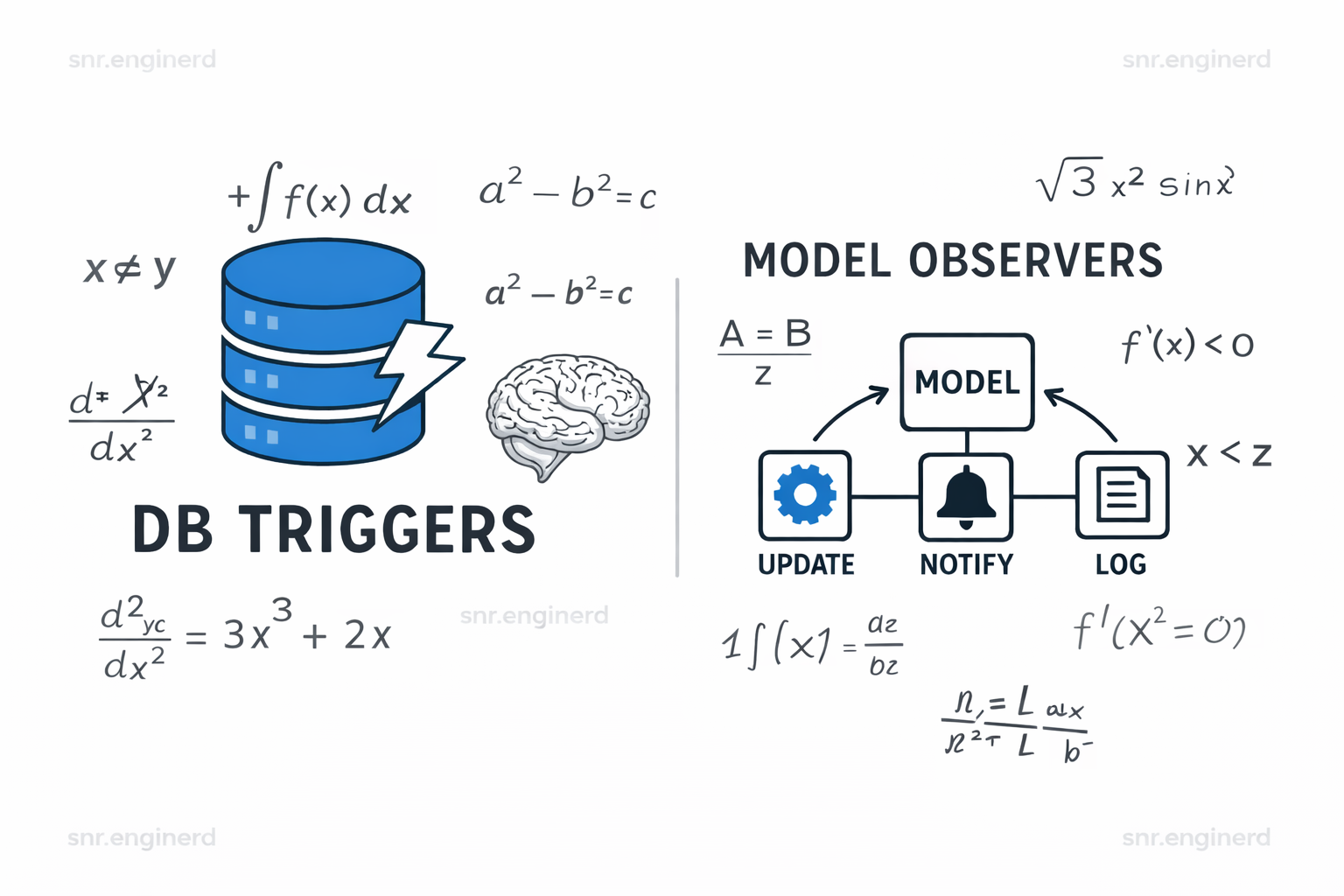
At one of my former jobs, I ran into database triggers for the first time.
Before that, I had never even heard of them. The codebase was legacy, and honestly, a lot of it felt like a mystery. Bugs were hard to trace. Some behaviors did not line up with what the app code suggested, which made debugging frustrating.
Eventually, one engineer who had database access found a set of triggers running in one environment. Not everyone on the team had DB access in that environment, so this was a big discovery. It explained why data was changing in ways we could not account for from the application layer alone.
This is not an anti-trigger post. Triggers can be useful. They run in the database when configured table events occur (commonly insert, update, or delete), so they can enforce certain rules consistently no matter which service writes to the table.
Our problem was not that triggers existed. Our problem was visibility and ownership.
There were many triggers, not enough documentation, and not enough shared understanding of what each one did. So every incident felt like detective work.
What changed for me with model observers
Later, I worked more with Laravel model observers, and that experience felt easier to reason about.
Observers are hooks tied to model lifecycle events like created, updated, and deleted. They run in the application layer, and the logic lives in code we can review and version-control.
- It was easier to read and review logic in pull requests.
- It was easier to debug with normal app tooling.
- New engineers could discover behavior faster by searching the code.
Where observers can still hurt
Observers are not automatically safer. They are broad around that model's Eloquent lifecycle, so logic can run from many call paths. If an observer contains heavy or destructive side effects, it can surprise you.
class CustomerObserver
{
    public function deleted(Customer $customer): void
    {
        // Can be dangerous if this is not expected everywhere
        $customer->orders()->delete();
    }
}
If everyone on the team expects this behavior, great. If not, you can accidentally delete more than intended.
Events and jobs for explicit control
Laravel events and queued jobs present better control in some cases.
Instead of attaching everything globally to model hooks, we could dispatch explicit domain events from specific use cases:
CustomerDeleted::dispatch($customer->id);Then listeners and jobs handle follow-up work. The big win is intent: the caller decides when that behavior should happen. That reduces accidental side effects, and makes side-effect flow easier to reason about during reviews.
All these patterns are trying to solve a similar problem: reacting to data changes and keeping related processes in sync.
The trade-off is mostly about:
- Visibility: where is the logic easiest for your team to find?
- Control: should behavior run globally, or only in explicit flows?
- Operability: how easily can you debug incidents at 2 a.m.?
Final thoughts
I do not think there is one universal winner here. In my case, working with triggers was a bad experience because of poor visibility, limited access, and hard-to-trace behavior. I have personally had a better experience with app-layer patterns like observers, events, and jobs for team velocity and debugging.
For me, the lesson is simple: hidden side effects are expensive, no matter where they live. If your team can clearly see, understand, and safely operate the behavior, you are probably on the right path.