

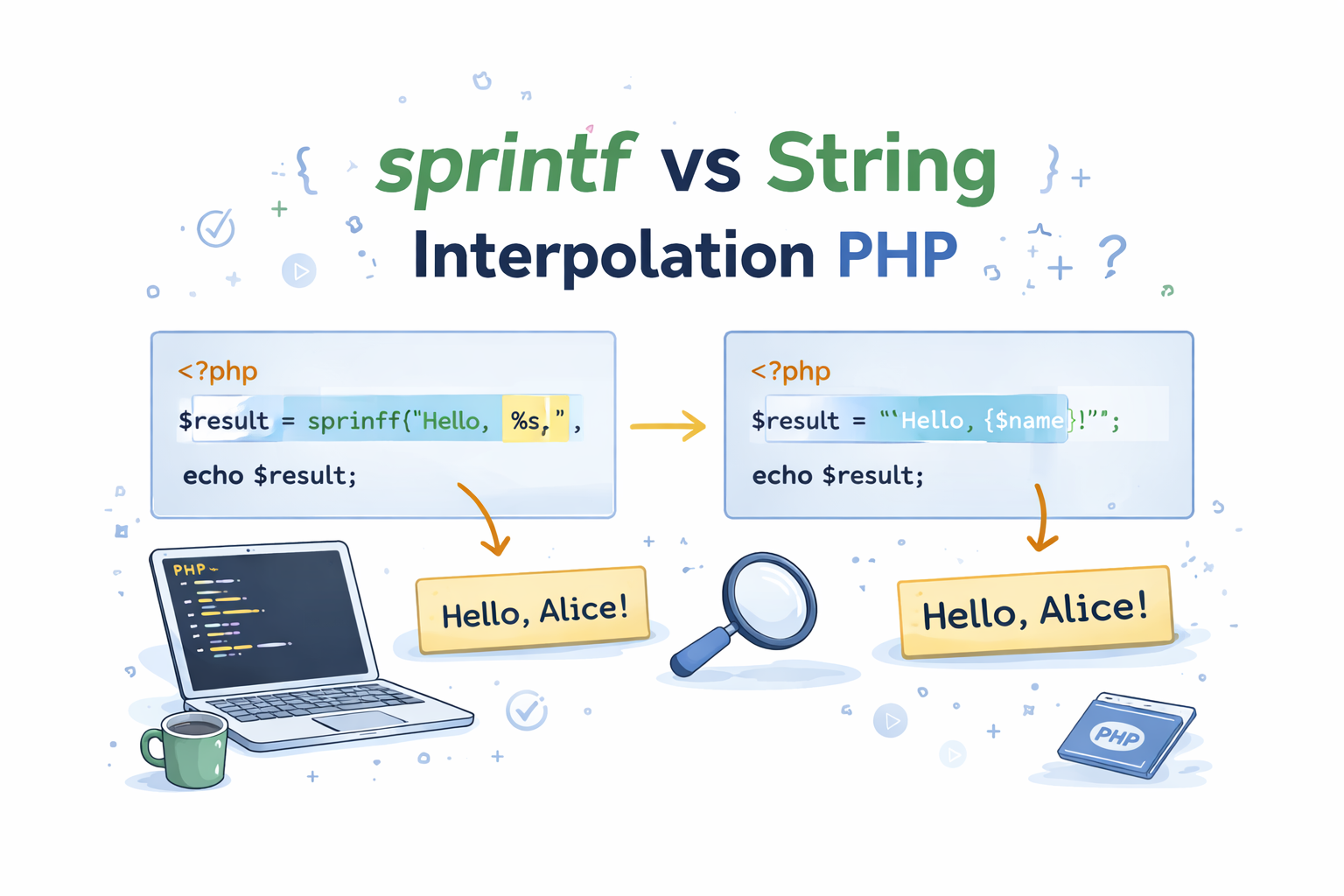
sprintf vs string interpolation
Introduction
Outputting some information and formatting the data in some cases is all part of the things we do as software engineers. There are different ways to achieve this, from concatenation, to interpolation, to functions like sprintf. I’ve used all three, and I still do, depending on the day, the codebase, or how readable it feels.
Concatenation
Concatenation is the “old faithful.” You’re just stitching strings together:
$name = "Flo";
$count = 3;
$message = "Hi " . $name . ", you have " . $count . " new messages.";
It’s easy to understand and works everywhere. But once the string gets longer (or you have lots of variables), it can start to feel a little noisy.
String interpolation
Interpolation is usually the most readable for me:
$name = "Flo";
$count = 3;
$message = "Hi {$name}, you have {$count} new messages.";
It reads like a sentence. Less punctuation, less glue. I reach for interpolation when I want something quick and clean.
Sprintf
sprintf is a formatting function that lets you define a template and “fill it in” with values:
$name = "Flo";
$count = 3;
$message = sprintf("Hi %s, you have %d new messages.", $name, $count);
For me, sprintf is home base. Part of it is the control — when I’m formatting numbers, padding, or keeping logs aligned, it just does what I expect. But another part is honestly habit. I’ve been lucky (or maybe just old enough) to work in teams and codebases where sprintf was the default, so it’s the first tool my hands reach for.
And I don’t see that as a bad thing. There’s something nice about using a tool you already understand deeply. I’m not trying to “win” with the trendiest syntax — I’m trying to ship readable, predictable code. sprintf helps me do that, and it’s still clear to anyone who’s been around the block.
Side by side comparison
sprintf | String interpolation |
|---|---|
|
|
Strong control over formatting | Very readable at a glance |
Great for localization/templating | Great for short, direct strings |
Slightly more verbose | Less ceremony |
So why do I still like sprintf?
Because sometimes I want that extra control, especially in older codebases or when I’m formatting numbers, dates, or alignment in logs. It’s also nice when strings get long and I want to keep formatting rules in one place.
Will I stop using it? Probably not. I think it’s one of those tools that sticks around because it solves a real problem, even if it’s not the trendiest.
If you’re debating which to use, I’d say: pick what makes the code easiest for you (and your team) to read later. That’s usually the right answer.
Final thoughts
None of these approaches are “wrong.” I’ve used all three, and I’ll keep using all three. When I want clarity, I lean on interpolation. When I want control (or I’m in an older codebase), I reach for sprintf. The best choice is the one that keeps you moving and keeps your code easy to read next week.